Tuesday, April 19, 2011
ART 350-EyeCon Update 3
My project is coming along nicely. I have finished building my canvases, five in total each 2' x 2'. I've also continued to play with the angle of the camera from above and have found a way I think works best. This of course will change once the piece is installed, but I at least feel better about the general angle and distance. After finding that both the Front Door and McNamara Galleries will not be available for me to install my piece on May 3, I've decided to try and install the piece in the northernmost stairwell of the CFA Building (near the painting studio), the one covered in graffiti and other artworks. This environment seems appropriate to invite people to interact with my work and express themselves on the canvas, hopefully drawing inspiration from the art surrounding them. I will ask Wendy to make sure it is okay to install my piece in the area and also if I may borrow an easel from the painting studio for the installation. I am glad to say I accomplished all the goals I set for this project in the last update. For next week, I need to confirm I can install in the stairwell and borrow an easel, play with how to incorporate different sounds in the same field, and be prepared to install (i.e having everything tested and ready).

Wednesday, April 13, 2011
ART 343-Mini-Golf Hole Update 2


I've finished modeling my mini-golf hole in SketchUp and have started putting the pieces together from the 2D pieces that Pepakura unfolded. There are a lot of pieces for this hole, and it looks as if it is going to take a long time to complete, but I am actually very excited to put it all together and see the finished product. I printed my pieces on the standard white printer paper from the lab, but plan on painting the hole once it is all assembled.
Tuesday, April 12, 2011
ART 350-Eyecon Update 2
Since last week I have narrowed down the number of tracks I am going to be using from twenty to nine. I believe this helps for it to sound more like a song, and less like a jumble of sounds going off all at once. I have also replaced most of the single time sound effects with looping beats. I played around with the camera position a bit and have found it difficult to create fields that work as well as I want from the overhead position, so I think I am going to have to work using the polygon tools, or find a different angle that will work better. I contacted the gallery to see if it would be possible to set up my installation in either the McNamara or Front Door Galleries on April 27, but was denied due to the Student Art Show the following day. I was just informed that these projects will not be due until May 3, so I will ask if it would be possible to install my project on that date. If that does not work I will try and find another suitable place to install. For next week I would like to have the camera position and angle figured out and working, have the polygon fields positioned in the areas needed to fill up the canvas area it is pointed at, and have the canvases built and ready to be painted on.
Wednesday, April 6, 2011
ART 343-Mini-Golf Hole Update 1


Tuesday, April 5, 2011
ART 350-EyeCon Update 1
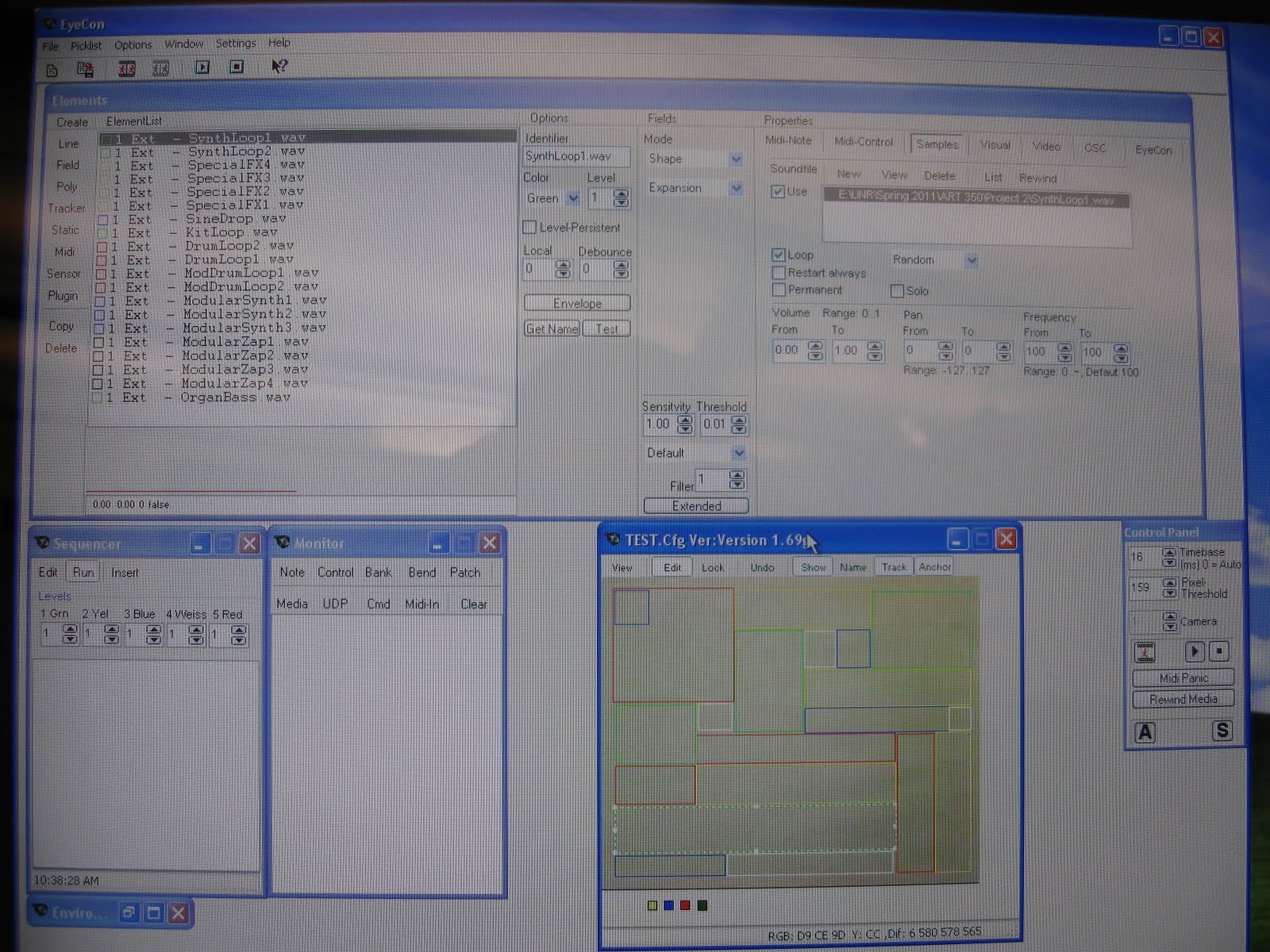
I have made some great progress over the week on my EyeCon project. I set a goal to play with the program a bit and test it's capabilities to see what I would and would not be able to do. So far I have been able to create 20 separate fields within EyeCon, all of which have their own .wav file. Each field is activated when EyeCon recognizes a change in the white background, such as paint being applied. I've set each field to "Expansion," which just means that the more of a field that is taken up, the louder the volume is for that certain .wav track. I initially downloaded a variety of sound files I thought would work well together to make a unique song, but after playing with them found that they do not actually all work that well together. I plan to continue looking for more sounds that mesh together better than the ones I have now. As for installation location, I don't have a specific location in mind yet. Somewhere where people would be able to be walking by a blank canvas and paints and be intrigued to let their artistic juices flow. Perhaps in the Front Door Gallery or in the McNamara Gallery.
Wednesday, March 30, 2011
ART 343-Mini-Golf Hole Declaration and Pepakura Figure
For this assignment I want to create a mini-golf hole that the user would make a hole-in-one every time. I would do this by creating my hole at an angle to ensure the ball, once hit, continues to roll until it is in the hole. I would like to design the hole with several interlacing paths that all end right at the hole. I think it would interesting to make the hole look like it is impossible, yet when the user tries it finds that they will make a hole-in-one every time they try. Pictures of my progress to come.
Picture of my Pepakura Andy Warhol

Tuesday, March 29, 2011
ART 350-Second Project Declaration
I would like to use the EyeCon to create an interactive musical painting for the second project of the semester. I have stumbled upon various websites like this one, where the user can create their own music simply by pressing a corresponding key on their keyboard. I want to take that idea to painting, but instead of pressing a key, the beats and synthesized sounds will be activated by painting on a canvas. I intend to have Eyecon focused on a canvas where people will be invited to paint on a blank canvas. I will create areas on the canvas that Eyecon will trigger to play a certain sound (either once or looped) if it notices a change, such as paint being applied. Hopefully, each song created will be unique just as each painting will be unique.
ART 350-Arduino Final Installation
We have finally finished installing our jellyfish in the 208A Gallery in the Church of Fine Arts at UNR. I have learned a lot from this project, both about the possibilities of Pepakura and of Arduino. I feel as if we have only scratched the surface of the potentials with both of these programs, and look forward to delving deeper into each of them as my work with digital art progresses. Although we originally planned to have more jellyfish, I think that only having three works well for the small gallery space. Each jellyfish is equipped with it's own Arduino along with six LED's programmed to blink in sequence. All in all, I am satisfied with how this project turned out.


Tuesday, March 8, 2011
ART 350-Update 3


We've managed to nearly complete our first jellyfish. When we proposed to make 10 of these jellyfish, we immensely underestimated how much time each one would take to create. Thus, with only two weeks remaining before this assignment is due, we've decided to downsize the scale and only create a few, 5 at most. We have a lot of work ahead of us, not only with building the jellyfish, but also with the Arduino and it's programming. We have had some progress with getting lights working and some other basic codes, but no luck yet with having it detect movement to activate the lights. We plan to spend a lot of time the rest of the week and over spring break in the digital media lab working with Clint and researching online to get this whole thing completed.
Wednesday, March 2, 2011
ART 343-Machinima
Our group, Jett Chapman, Max Simone, and myself, decided on reenacting a portion of the very intense documentary "The Bridge" by Eric Steele. We chose to focus on one particular man, Gene Sprague, who took his life on the Golden Gate Bridge in 2004. We found a beautifully rendered replica of the bridge in Second Life and created an avatar that looked similar to Gene Sprague. We used audio and some video from the documentary along with scenes filmed in Second Life to create our machinima. Over all, I am pleased with how the machinima turned out. It is an interested concept in my mind of creating a documentary, which is supposed to be all about capturing something that is real, but doing so in a virtual environment. I think the actual documentary footage we used is very powerful, but after watching in class and seeing the other students reaction feel it would have been more powerful had we just used the footage of Mr. Sprague jumping from the bridge. We could have created the entire rest of the machinima in Second Life and left the part he jumps off as real footage, just to remind the viewer that it in not all fantasy.
ART 343-Digital Nation Analysis
I found this documentary to be very insightful and brought many pressing issues in our "digital nation" to light. Many of the issues and subjects they cover throughout this documentary are relevant not only to myself, but to others around the world. The first point in the documentary that really got me thinking was the notion that people are being introduced to media and digital technology at younger and younger ages, well before their brains are done fully developing. How might this effect the future generations? What kind of advantages and/or disadvantages might this have on future generations? I recall the kinds of digital technology I had available to me as a child, and am amazed at the progression it's made in the short period of time since then. How will this rapidly changing world effect generations young and old, and will it, or has it already come to pass that technology is progressing too quickly for some to keep up with?
The documentary also pointed out that when print was introduced it inhibited the use of our memory because we no longer were required to memorize things, we had a way to document them. It seems with the introduction of digital media, at this point, to be inhibiting our attention span. As pointed out by the students at Stanford and MIT, we are constantly pulled into hundreds of directions by different forms of technology. Our generation like to believe that we are master multi-taskers, but as the studies showed, and as I can relate from experiences, we are not. We are masters of being distracted by the most insignificant and meager things. How, as technology continues to progress and new and more interesting ones emerge, will it effect us?
Since new technologies are constantly pulling is in so many directions, it appears the way we ave responded is by alienating ourselves from other people and the world around us. I've had numerous situations where people will nearly walk right into me because they are too busy looking down at their cell phones or engulfed in their music that's coursing through their ear-buds. So how do we reconnect with people, with society? Virtual worlds like Second Life and World of Warcraft seem to be the way we are heading. Unlike the real world, these virtual worlds actually encourage people to interact, to team up and accomplish something. Will it come to a point where the only way we socialize or interact is through virtual worlds like these?
A final question that was raised by correspondent Douglas Rushkoff that I found intriguing was:
"We're all together out on the Internet, alone; or alone out on the Internet together. Does this virtual world really bring us together with others? Or does it just make being utterly alone a little more bearable?"
It's a sobering thought to really consider, and one that I'm sure will be answered here in the near future.
Wednesday, February 23, 2011
ART 350-Arduino Update #2

We have made some good progress since the last update. Pictured above is the the resulting image of our jellyfish after it has been flattened out in the Pepakura Designer program. We have printed it out on a standard letter sized paper to get an idea of what the folds and attachments we will need to make. However, it is much too small on this size paper to begin trying to put it together. So, we will need to either print each individual part out on a separate page, or print the entire thing out on a larger sized paper. Also, still working on getting all the supplies needed for the Arduino portion of the project. More updates to come.
Tuesday, February 22, 2011
ART 343-Second-Life Performance Proposal

The idea behind my performance proposal is for the entire class to be dressed as giant monkey's (pictured above), roam around in Second Life and to "monkey around." As someone mentioned during our critique, I think it would be interesting to have one of us dressed as a giant banana with the rest of us chasing it around. Additionally, I'd like to have the following song by The Monkees playing while we are in costume.
Thursday, February 17, 2011
ART 350-Arduino Update #1

The last couple weeks have been filled with much trial and error and trying to land on a concrete idea of what the project was going to be. Justeen and I have decided to work on this first project together and to create an underwater like world full of jellyfish within a gallery setting. We just recently purchased a 3D model of a jellyfish (pictured above) we plan to use as a template to create our own jellyfish. We've been working in Pepakura, a program that allows us to create paper models from 3D data, to try and make the most realistic looking jellyfish possible. Once we have Pepakura all figured out and our jellyfish in production (we plan to make at least 10), we will be using the Arduino to light the jellyfish up and possibly make them move. The plan at this point is to have the jellyfish made out of a transparent fabric, EL Wire in the bell of the model to give it light, Fiber Optic Lights as the tentacles, and possibly Fiber Optic Ribbon for the oral arms. The Arduino will have a motion sensor attached to detect any movement in the gallery and activate the lights in the jellyfish. There is still a lot of work to go but I am excited to see the project progress.
Monday, February 14, 2011
ART 350-Reading Questions
From Interactive Art on the Internet by Eduardo Kac
1. Seeing as how the Internet has virtually no censorship and that anyone connected may upload whatever they desire, how might this effect artists using the Internet as an interactive medium and the deeply rooted idea that art has a social responsibility, either negatively or positively?
From On Totalitarian Interactivity by Lev Manovich
2. The final paragraph of the essay reads, "This (interactive computer media) is a new kind of identification appropriate for the information age of cognitive labor. The cultural technologies of an industrial society -- cinema and fashion -- asked us to identify with somebody's bodily image. The interactive media asks us to identify with somebody's else mental structure." If this is true, will it come to pass that interactive computer media will put the same pressure on society to conform to a certain "mental structure" the way that cinema and fashion have with bodily images?
Sunday, February 13, 2011
ART 343-Second Life Avatar and Object Comparison


For this assignment we were to create a realistic self-portrait avatar as well as an object from our daily lives in the online virtual-world of Second Life. I had created a self-portrait avatar previously in Second Life for the beginning Digital Media class, which can be viewed here. I feel that my second attempt at my avatar was much more successful, due in part to the fact that I had spent more time in Second Life figuring out it's capabilities as well as using a skin template to import an actual image of my face rather than using the default skins. I am pleased with the way my avatar turned out, but feel as if there are still some things I can do do to make it truly look just like me.
As for the object I created, I decided to create a replicate of my Sony PSP. Again, I was pleased with the way it turned out, but still feel like there is more that I can do to make it seem truly realistic. This was my first time creating in object in Second Life, but found the build feature to be pretty simple and fun to play around with. I look forward to spending more time in Second Life and discovering more possibilities and ways to expand my ideas as a digital media artist.
Tuesday, February 1, 2011
ART 343-Art & the Avatar Discussion Questions
1. In one of the responses to the article, left by Sowa Mai, it discusses the issue of entering a virtual world with our perspective still intact. These perspectives are based on situations and events experienced in the real world. In my mind I wonder whether or not our perspectives, while in a virtual world, are worth anything. In a place where we can be anyone or anything we want, where we can do things we as real people would never dare to do for fear of seclusion or judgment, in a realm where anything goes, do these perspectives matter?
2. The society we live in trains us to expect unrealistic and unachievable attributes of ourselves and of each other via commercialized mass media. We are bombarded with commercialized images of the ideal body, the ideal home, the ideal lifestyle day in and day out. For this reason, the ambiguity of identity while in a virtual world can be extremely attractive. In a virtual world we have the freedom to alter any indicators of age, race, gender; to be anyone we want to be. In reality, we are pressured to be all of these ideal things with just a hint of hope that we may someday be, but in a virtual world we have the choice to be whoever we want, whether that be the ideal image that we feel pressured into being, or anything else we may have our hearts set on. The question I pose in this case is that since we live in a society that puts this sort of pressure on us daily, why wouldn't we be attracted to escape to a place where we can actually be exactly who we want to be without the fear of being ridiculed for not following the societal norm?
Wednesday, January 26, 2011
ART 343-HUD Display

Click to view in larger size.
This was my second go at creating a HUD as a self-portrait, the first being one created for the beginning Digital Media, ART 245. That one can be viewed here for comparison. For this one I wanted to create a HUD that represented something about me that I love to do, which is skiing. I chose to represent this in a first-person POV because I felt it would give the viewer a better feel of the exhilaration and beauty I see when I ski as opposed to a third-person view. I really enjoy the way this HUD turned out and am glad I decided to create something from what I do rather than take something already done and make it my own like I did in the previous HUD display.
Thursday, December 2, 2010
Artist Lecture - Matteo Bittani
I have been playing video games for as long as I could remember. Through all my years sitting in front of the television screen, the countless hours button mashing trying to beat every game thrown my way, the numerous controllers and game systems I've sent to the junkyard after losing my temper for a split second after being bested by a silly machine, not once had I imagined combining video game culture with art culture. That was until I attended Matteo Bittani's lecture at UNR November 4. Bittani has found a unique way to combine these two similar cultures to create a new and interesting form of artwork. Bittani not only creates video game art, but also catalogs and shares other artist's work on his website www.gamescenes.org. Naturally, being a fan of both video game and art culture, I appreciated much of the work that Bittani was creating and sharing on his website. Bittani's project Bruno, about his friend's suicide, was one that intrigued me the most. He reenacted what he imaged the final several minutes of his friend's life was like through the game Mirror's Edge. Before Bittani explained the concept behind this piece I was utterly confused by it. After he had explained what it was about though, I found it very compelling and conceptually very deep. All in all, I greatly enjoyed Bittani's lecture as it opened my eyes up to a whole new genre of art work through the use of video games.
Artist Lecture - Extreme Animals

Jacob Ciocci and David Wightman (Extreme Animals) combine live music, video, and staged theatrics to create a unique and intriguing type of art that I have yet to see be duplicated elsewhere. I attended their show at the JCSU on September 8 not knowing what to expect, and for the first 15-20 minutes wondering if their performance was a joke. They began by showing numerous YouTube videos dealing with "tween" culture. Just as I was considering leaving this so-called "performance" art, their real artwork was presented in the form of high-energy music and synthesized sound with in-your-face videos that would make the frail of heart succumb to a mild seizure. Their mash-ups of video art appropriated from various movies, TV shows, cartoons, etc. kept my eyes glued to the screen trying to figure out what exactly I was looking at, but I was hardly able to comprehend what was in fact going on because it was all moving so quickly. Even though I did not understand what was happening, I realized I didn't need to. It seemed to me that was their intention, they were trying to bombard you with numerous images mixed and mashed up with bright, flashing colors and loud synthesized sounds. In the end, I wouldn't say that I 'liked' Extreme Animals, but it did open my eyes up to some new types of possibilities of art that I had not thought of. I have always tried to be very precise and controlling with my art work, but after watching this performance I was inspired to explore the sort of randomness that the Extreme Animals seemed to embrace in their work.
Gallery Review - Paho Mahn

I viewed Paho Mahn's joint exhibition in the Sheppard Gallery on September 15. When I initially entered the gallery I was immediately drawn to Mahn's pieces. His pieces consisted of photographs of individual recyclables organized according by color. Each piece was placed on a solid black background which made the colors of the recyclables "pop" and created a vibrant contrast that drew the viewer in more closely. His work dealt with environmental awareness and and the rate of consumption of resources today. I am not usually a big fan of works dealing with this subject because it seems so overdone nowadays and to an extent has become cliche. Mahn's pieces, however, were an exception. His work really seemed to get a strong message across to me about how wasteful our nation has become. As a stickler for organization myself, I appreciated how neat and clean each of his pieces were composed. He scaled each object to be the same size and organized and spaced them neatly. In totality, I really enjoyed viewing Mahn's exhibition; not just for it's aesthetic values, but also for the way he approached the cliche subject matter in a unique way.
Wednesday, December 1, 2010
Final Project: The Hidden Me
Also available to view on my YouTube Channel
The Hidden Me was the first collaborative project for the Justeen and myself. Our individual artworks differ in many ways, from materials to subject matters and everything in between. This collaboration began as a challenge to find a unique way to portray both of our individual artistic styles. Our intention for this video was to depict the alter egos of two individuals. We all hide behind the masks of what we define as normal, and through this video we unmasked each persons hidden self layer by layer.
Thursday, November 25, 2010
Project #7: The Big Screen Project
Also available to view on my YouTube Channel
For this project we needed to create an original video and sound work as a large screen public artwork that would be submitted for review by a curator for The Big Screen Project in New York City. We were allowed to either work alone or collaborate with another student for this project, so Justeen and I decided to team up for this one and create a video using both of our ideas. We wanted to communicate the concept that each of us have alter-egos, different personalities that we hide behind the masks of normality. We also wanted to portray some different areas in Reno that may seem exotic to people viewing this video in New York City (if it is chosen to be projected). Our audio was created with the knowledge that not everyone who may see the video in New York will have access to hear the audio. I was very happy with the way this project turned out and had a fun time collaborating with Justeen and hearing a lot of different ideas that I may never have thought of. I am excited to continue working on and perfecting this project for our final project of the semester.
Monday, November 1, 2010
Project #6: Video and Sound Triptych
Also available to view on my YouTube Channel
For this project we were to create a video and sound triptych for installation in the new Church of Fine Arts 208A Gallery. They were intended to further develop our conceptual expressions through video and sound. Each video was to be distinct and yet relate to one another. I approached this project with the intent to further express a self-portrait, an underlying theme of many of our projects up to this point. I wanted to display a virtual self-portrait with the use of three different extreme sports, each portrayed through unique points of view. They are meant to be started simultaneously and have all been created to be the same length so that they would continue to loop synchronized. However, when presenting these in-class they did not sync up perfectly, but I found the music to have an echoing effect that was rather interesting. I really enjoyed creating this triptych, and if I had the chance to redo this project I'd have liked to do more with the sound and also work on the effects a little more. All in all, I am happy with how it turned out though.


Tuesday, October 5, 2010
Project #5: Sound and Video Montage (chance)
Also available to view on my YouTube Channel
When comparing my controlled video versus my chance video, I take much more of a liking to the chance for several reasons. First of all, my chance operation was one that was extremely fun for me to work with. On Monday night, during the lightning storm, I watched from my back porch for about an hour, recording every time I saw lightning flashes. I translated that hour of lightning into my minute long video by changing video clips every time there was lightning. If there were more than one lightning bolts at once, I reversed the video. The amount of time between the lightning and thunder determined how much I slowed down or sped up the video. Secondly, I think I enjoyed the chance video more because I did not set any expectations for it like I had with my controlled video. I just purely enjoyed making it using the lightning strikes as my chance operator.
Sunday, October 3, 2010
Project #5: Sound and Video Montage (controlled)
Also available to view on my YouTube Channel
My intent for my controlled video was to create a sort of narrative using appropriated videos and images I'd found on the internet. I had just recently watched Banksy's documentary Exit Through the Gift Shop and it had inspired me to make my video deal with the relationship between what is considered Fine Art and Street Art. My first several attempts at this were failures in my opinion and I just couldn't get the videos I was creating to replicate the ideas I had in my head. After several frustrating hours I decided to give up on creating the masterpiece I had envisioned, but still went with the narrative idea. I am not particularly happy with how this video ended up just because it isn't what I really wanted to do.
Monday, September 20, 2010
Project #4: Five Track Mix (chance)
For my chance mix I reverted back to the original five track mix rather than using the controlled mix. For my chance element I chose to use a simple die. For each track I would roll the die and whatever number it landed on I would scroll down that many on the effects list in GarageBand and choose that effect. I'd roll again and scroll down from the previous effect I'd selected. A simple yet effective method in choosing random effects. I left the volume on each track at their original setting, and now I sort of wish I had done a little more manipulation with that. All in all though, I'd say that the chance mix turned out interesting.
Project #4: Five Track Mix (controlled)
For the second portion of the fourth project we were to take our five track mix's and create two separate mixes. The first was a controlled mix where we could consciously choose how to manipulate each track with effects and volume. The process I used was muting every track except one and finding an effect for that track that I thought sounded interesting, muting that track, moving on to the next, and so on. Once I had found an interesting effect for each track I adjusted each tracks volume to a level I thought appropriate. The end result was something I found rather interesting, a sort of ambient mesh of echoing sounds that make me imagine being underwater or semi-unconscious.
Project #4: Five Track Mix (no effects)
Our fourth project consisted of combining the audio of all previous projects done thus far. This five track mix is compiled of my tape loop self-portrait, a loop of my homemade instrument being played, my spoken word self-portrait, the Van Halen tape loop, and the Fantasia vinyl loop. There are no added effects, that is for later in the project.
Fantasia Vinyl Loop
For this project we were to create a short loop from a vinyl record playing using a homemade record player. This player consisted of some tape, a chop stick, a small nail, and an empty yogurt container. All in all, this project was fun and challenging. I enjoyed learning how to make a record player; however, trying to get consistent sound out of it was rather difficult. I chose the Fantasia vinyl from the local Salvation Army because, again, it was one that I thought would make good use in an experimental sound class. I wasn't able to get the best audio for this project, but found the project interesting in of itself.
Van Halen Tape Loop
For this assignment we were to take apart an old tape, cut it up, and create a short tape loop from a randomly selected portion of the tape. I used Van Halen's 5150 tape because while searching at the local Salvation Army it was the only one that caught my eye. I enjoyed the process of taking the tape apart and putting it back together (something I've enjoyed doing since I was a kid), and it got me thinking of different kinds of projects that I could do with sound and tapes.
Wednesday, September 15, 2010
Project #3: Spoken Word Self-Portrait
For our third project we to consider our voices as instruments and create a spoken word self-portrait. As soon as this project was assigned I began to write things down in my notebook about who I thought I was and things people may not know about me without really getting to know me. This was the best way I could think to create a spoken word self-portrait.
Project #2: Build an Instrument
For the second project we were to continue with the idea of "found sound" by creating our own home-made musical instruments. After some research online of home-made instruments that other people had made, I came to the conclusion that a drum would probably be the easiest and least time-consuming instrument to make (although I considered making some sort of guitar as well). I gathered some materials I thought would work well in making a drum, (some stove-top burner liners, metal hangers, strong sticky paper, and some key ring accessories for additional flare) and started hot-gluing it all together. In the end, I was satisfied with the way my instrument had turned out, and yet again demonstrated my obsession with planning and order.
Project #1: Tape Loop Self-Portrait
For our first project we were to use an endless tape loop (mine is about 20 sec.) and portable tape recorder to record "found sound" that was familiar to our everyday experiences. These sounds were to serve as an audio self-portrait. For my recording I planned out several sounds that I knew I heard every day and I felt represented me well. I recorded them exactly at the point I wanted to for the exact amount of time I had planned. In doing so, although I did not realize at the time, it also provided an image of how obsessed I am with things being planned and in order. I began to realize this once we shared our loops in class and heard the complete randomness of some of the other students. So, in a sense, this project is a self-portrait in two different ways.
Wednesday, May 5, 2010
FIANL PROJECT: IRAQI MEMORIAL PROPOSAL
For my final project I decided to submit a proposal for the Iraqi Memorial project. When conceiving my idea for the Iraqi Memorial, I had one thought in mind: What is the price of an innocent human life? To me it seems that the Bush administration decided that innocent human lives are worth less than the prospect of acquiring foreign oil. For my proposal I intended to create a piece that represented this concept, and I believe that I have successfully done so. It represents our nation's dependency on foreign oil, even at the price of life. My piece, entitled "The Price of War" consists of a replication of a human heart painted with the Iraq flag to represent the innocent Iraqi civilians that have been killed during "Operation Iraqi Freedom." From this heart would drip a single drop of oil for each time an innocent civilian is killed. The oil would drip into a sculpture in the shape of hands that is painted with an American flag. The oil would collect in the hand shaped sculpture and, eventually, would overflow into a larger pool of oil resting below. I feel this memorial would be best placed in a gallery setting, such as an Iraqi Memorial Gallery, if one was to exist.


GALLERY REVIEW


I visited the Nevada Museum of Art during mid-April to view the exhibits and see what other artists, local and foreign, were creating. It was my first time visiting the museum, and I was eager to survey the works of art on display.
I was on the fence about most of the exhibits at the museum. In general, I didn’t really like most of them. It wasn’t that they weren’t any good, it was more so that they were pieces that I couldn’t really make a connection or relate to.
One exhibit, on the other hand, was one that I was immediately drawn to when I stumbled upon. It was entitled “Views From China” by Yang Yongliang, a young artist from Shanghai, China. Yongliang combines traditional Chinese paintings with the modern Shanghai city life and the details reveal current urban culture.
I was immediately drawn to this exhibit because I felt like it was something that I could relate to and, in my eyes, the pieces were aesthetically pleasing. At first glance, Yongliang’s pieces look just like traditional Chinese paintings depicting Chinese landscapes and a collection of what looked like an explosion above a cityscape.
But upon closer examination I noticed that these simple landscapes and explosions had much more to them. The landscapes were cleverly crafted from digital photographs of China’s bustling cities, and then manipulated into haunting imaginary landscapes that critique China’s rapidly changing built environment.
Yongliang depends heavily on his a camera and a laptop computer to make his art, similar to what I enjoy doing with my artwork. Using only these tools—and a knowledge of traditional Chinese painting traditions—Yongliang invents urban scenes that depict skyscrapers under construction, freeway systems, electrical power plants, and bustling urban corridors. His compositions starkly reveal the impacts of technological progress that China has undergone over past decades.
Beyond these pieces being aesthetically pleasing, I think I really enjoyed them because subconsciously I am attracted to art that hides a deeper meaning that challenges the viewer to really look at the artwork and think critically about what it represents. Yongliang’s pieces do just that and inspire me to try to do something similar in my own way.
IRAQI MEMORIAL SYMPOSIUM LECTURE
I attended the Iraqi Memorial Symposium on Thur., March 4, in the IGT Knowledge Center at the University of Nevada, Reno. The symposium consisted of several contributors to the Iraqi Memorial project talking about their proposals and their interpretations of the project. At the time, I don’t think I fully understood the concept behind the project, and thus found the symposium a bit dull.
However, after completing my own proposal for the Iraqi Memorial project, I feel as if I gained a new understanding for the concept of the project and what the speakers were trying to convey through their pieces. There is more to this project than just having people submit ideas for a memorial. It is a way for artists, designers, architects, and other interested creative individuals or collaborators to create artwork that dealt with the contemplation of loss, to honor sacrifice, to celebrate heroism and to sanctify a process of mourning that is ongoing and public.
Looking back on the symposium, I realize that the contributors who were brought to speak at our school and share with us their proposals had understood this and created works of art that they felt represented the above things in a way that best fit their views.
The visiting contributors brought with them a wide range of ideas for the project, some of which I enjoyed, and others that I don’t really feel I could grasp the meaning of. “Light Trails,” by Cat Soergel Marshall, was one of the pieces that I just couldn’t really grasp a hold of. Her proposal is a moveable memorial installed at various Iraqi locations that consist of, as far as I could tell, giant rope of light that extends through regions of Iraq. Marshall said, “The piece narrates the causality figures through distance, time, light and energy.” As I said earlier, I just couldn’t grasp a hold of this piece, but am sure it’s a superb proposal in it’s own right.
A proposal that I enjoyed was “The Killing of Lions: An Iraqi Memorial,” by Maureen Drdak. The piece draws upon the representation of lion hunts as the eloquent and ironic metaphor for the War in Iraq. The lions represent the “powerless” Iraqi civilian dead, and mineral threads express the unseen, impersonal violence, which penetrates these lion like souls. I enjoyed this piece for its simplicity and underlying meaning the most. It was uncomplicated and easy to understand, and yet, at the same time, very effective in getting it’s meaning across.
I think the symposium was a great way for the contributors to the Iraqi Memorial to share their views on the project and their proposals. After completing my proposal, I look back at the symposium with a new view of what the contributors were trying to convey and have a new respect for the ideas each of them created for the memorial.
EDDO STERN LECTURE
I attended Eddo Stern’s lecture on Wed., April 14, in the William Raggio Building. He showed many of his artworks while explaining his interpretations along the way. I liked many of his works, and others not as much.
Eddo Stern creates what he calls, “playable artwork which is very interactive.” He is a video game designer/artist and teaches at UCLA.
Eddo Stern works on the disputed borderlands between fantasy and reality, exploring the uneasy and otherwise unconscious connections between physical existence and electronic simulation. His work explores new modes of narrative and documentary, experimental computer game design, fantasies of technology and history, and cross-cultural representation in computer games, film, and online media.
He works in various media including computer software, hardware and game design, kinetic sculpture, performance, and film and video production. He is currently developing the sensory deprivation game Darkgame.
The first piece he showed was video of Tekken Torture Tournament, a video game hack of Tekken Tag Tournament. This hack required that two participants were connected to an EMS Stimulation Machine that would electronically stimulate them each time there characters were injured.
I enjoy the design of Tekken Torture Tournament having a physical interaction. It creates a new dimension to the world of video games. It is one that I imagine could someday be a norm, to create a physical connection between a player and its avatar.
Another of my favorite pieces that Stern showed was his game being currently developed, Darkgame. In this multi-player video game a player is deprived of certain senses in exchange for powering up other senses. For instance, by giving up your vision, you gain greater sensory detail in hearing, or speed. I found this concept interesting, and would like to try the game to grasp a full understanding of how it all works.
Another of Stern’s works that I enjoyed was the series of Kinetic Shadow Puppets. I liked these for different reasons than the others. I liked these simply because they were nice to look at in a gallery setting, and could even be placed in a home. They weren’t anything new or too different from things other people had done, but they were very well done.
All in all, I enjoyed the lecture that Stern put on and found several of his ideas captivating and made me re-think my own processes and ideals when I go about doing my artwork.
Tuesday, May 4, 2010
FINAL WRITING ASSIGNMENT
Throughout the spring 2010 semester many artists and artworks were covered. There were many that I enjoyed, others that I did not, some that required me to think deeply about the concept or meaning, and others that were simply pleasant to look at. As the semester proceeded and the lessons became more focused on recent works rather than the beginnings of digital media, I found myself becoming further interested in the subject. It’s my belief that to understand where something is going, such as digital media, you must first understand where it came from. That is why I believe that as the semester proceeded and I began to understand further how digital media came about, the more I became interested in the subject.
The three artists that I am choosing to research and compare works are Eddo Stern, The Yes Men, and William Kentridge. All three of the artists were covered in the final weeks of the semester and are three whose works I found appealing.
Eddo Stern works on the disputed borderlands between fantasy and reality, exploring the uneasy and otherwise unconscious connections between physical existence and electronic simulation.
His work explores new modes of narrative and documentary, experimental computer game design, fantasies of technology and history, and cross-cultural representation in computer games, film, and online media. He works in various media including computer software, hardware and game design, kinetic sculpture, performance, and film and video production.
After attending Stern’s lecture in mid-April and researching more of his work, I found his ideas and concepts intriguing. I also enjoyed the idea of physical interaction, like the electronic stimulation in Tekken Torture Tournament, in the ever-expanding world of video games.
After researching more of Stern’s works I found many that I found compelling, such as the series of Kinetic Shadow Puppets. The shadow puppets were narratives consisting of plastic, paper, and electronics. According to Stern, he spent a year-and-a-half playing the online-game World of Warcraft, and after that was struck with many ideas to create new works of art, including the Kinetic Shadow Puppets.
The shadow puppets were a different type of work compared to most of Stern’s other works, which dealt with hacking or programming video games. The puppets were a simple way to tell a narrative, such as “Man, Woman, Dragon” which was based on World of Warcraft. It is a representation of Chuck Norris fighting a dragon, with a she-elf doing what looks like casting a spell, but I’m not certain.
A collection of Eddo Stern’s work can be found at: www.eddostern.com
The Yes Men are a group of culture jamming activists who practice what they call “identity correction” by pretending to be powerful people and spokespersons for prominent organizations. They create and maintain fake websites similar to ones they want to spoof, and then they accept invitations received on their websites to appear at conferences, symposia, and TV shows. They express the idea that corporations and governmental organizations often act in dehumanizing ways toward the public.
Elaborate props are sometimes part of the ruse, as demonstrated in their 2003 DVD release The Yes Men and their 2009 film The Yes Men Fix the World.
After watching a short clip of The Yes Men Fix the World in class, I proceeded to rent the film and watch it in its entirety. I must admit that it was a film I found intellectually stimulating that really required me to think deeply about many of the “identity correction” schemes they were participating in.
The film The Yes Men Fix the World starred Andy Bichlbaum, Mike Bonanno, and Reggie Watts. Perhaps one of the Yes Men’s “identity correction” plans, in my opinion, was Andy Bichlbaum appearing on BBC World on the twentieth anniversary of the Bhopal disaster as a Dow Chemical spokesman.
Bichlbaum announced Dow was accepting full responsibility for the chemical disaster that killed thousands and left over 120,000 requiring lifelong care. Bichlbaum went on to announce Dow planned to liquidate Union Carbide, the company responsible for the chemical disaster, and use the resulting $12 billion to pay for medical care, clean up the site, and fund research into hazards of other Dow products.
These announcements caused the Dow stock to decline in value of more than $2 billion in just over two hours. After the original interview was revealed as a hoax, Bichlbaum appeared in a follow-up interview on the United Kingdom's Channel 4 news. During the interview he was asked if he had considered the emotions and reaction of the people of Bhopal when producing the hoax. According to the interviewer, "there were many people in tears" upon having learned of the hoax. Bichlbaum said that, in comparison, what distress he had caused the people was minimal to that for which Dow was responsible.
The Yes Men claim on their website that they have been told by contacts in Bhopal that once they had got over their disappointment that it wasn't real, they were pleased about the stunt and thought it had helped to raise awareness of their plight.
It seems to me that this is the goal of The Yes Men; to raise global awareness about the way corporations and governmental organizations act in dehumanizing ways. I really enjoyed the film and plan to continue to follow their work as it has caused me to question the way corporations and governmental organizations act.
The Yes Men’s official website can be located at: www.theyesmen.org
William Kentridge is a South African artist perhaps best known for his animated films. These are constructed by filming a drawing, making erasures and changes, and filming it again. He continues this process meticulously, giving each change to the drawing a quarter of a second to two seconds' screen time. A single drawing will be altered and filmed this way until the end of a scene. These drawings are later displayed along with the films as finished pieces of art.
After watching a short clip of one of Kentridge’s works in class, I was immediately reminded of watching more of his work the previous semester while in Jeremy’s art class. I remember seeing it for the first time and wondering how much work must go into each one of his films. Although most are moderately short, it still seemed to me that the processes that Kentridge must go through would be long and tedious. But the finished piece is astonishing and worth the monotonous work put into it.
The political content and unique techniques of Kentridge's work have propelled him into the realm of South Africa's top artists. Working with what is in essence a very restrictive media, using only charcoal and a touch of blue or red pastel, he has created animations of astounding depth.
A theme running through all of his work is his peculiar way of representing his birthplace. While he does not portray it as the militant or oppressive place that it was for black people, he does not emphasize the picturesque state of living that white people enjoyed during apartheid either; he presents instead a city in which the duality of man is exposed. In a series of nine short films, he introduces two characters - Soho Eckstein and Felix Teitlebaum. These characters depict an emotional and political struggle that ultimately reflects the lives of many South Africans in the pre-democracy era.
Most of all though, I really just enjoy watching Kentridge’s films and imaging the processes that he must go through to get a work completed. It inspires me to create something as magnificent as his films and makes me hope that someday I may inspire someone the way Kentridge has inspired me.
The three artists that I am choosing to research and compare works are Eddo Stern, The Yes Men, and William Kentridge. All three of the artists were covered in the final weeks of the semester and are three whose works I found appealing.
Eddo Stern works on the disputed borderlands between fantasy and reality, exploring the uneasy and otherwise unconscious connections between physical existence and electronic simulation.
His work explores new modes of narrative and documentary, experimental computer game design, fantasies of technology and history, and cross-cultural representation in computer games, film, and online media. He works in various media including computer software, hardware and game design, kinetic sculpture, performance, and film and video production.
After attending Stern’s lecture in mid-April and researching more of his work, I found his ideas and concepts intriguing. I also enjoyed the idea of physical interaction, like the electronic stimulation in Tekken Torture Tournament, in the ever-expanding world of video games.
After researching more of Stern’s works I found many that I found compelling, such as the series of Kinetic Shadow Puppets. The shadow puppets were narratives consisting of plastic, paper, and electronics. According to Stern, he spent a year-and-a-half playing the online-game World of Warcraft, and after that was struck with many ideas to create new works of art, including the Kinetic Shadow Puppets.
The shadow puppets were a different type of work compared to most of Stern’s other works, which dealt with hacking or programming video games. The puppets were a simple way to tell a narrative, such as “Man, Woman, Dragon” which was based on World of Warcraft. It is a representation of Chuck Norris fighting a dragon, with a she-elf doing what looks like casting a spell, but I’m not certain.
A collection of Eddo Stern’s work can be found at: www.eddostern.com
The Yes Men are a group of culture jamming activists who practice what they call “identity correction” by pretending to be powerful people and spokespersons for prominent organizations. They create and maintain fake websites similar to ones they want to spoof, and then they accept invitations received on their websites to appear at conferences, symposia, and TV shows. They express the idea that corporations and governmental organizations often act in dehumanizing ways toward the public.
Elaborate props are sometimes part of the ruse, as demonstrated in their 2003 DVD release The Yes Men and their 2009 film The Yes Men Fix the World.
After watching a short clip of The Yes Men Fix the World in class, I proceeded to rent the film and watch it in its entirety. I must admit that it was a film I found intellectually stimulating that really required me to think deeply about many of the “identity correction” schemes they were participating in.
The film The Yes Men Fix the World starred Andy Bichlbaum, Mike Bonanno, and Reggie Watts. Perhaps one of the Yes Men’s “identity correction” plans, in my opinion, was Andy Bichlbaum appearing on BBC World on the twentieth anniversary of the Bhopal disaster as a Dow Chemical spokesman.
Bichlbaum announced Dow was accepting full responsibility for the chemical disaster that killed thousands and left over 120,000 requiring lifelong care. Bichlbaum went on to announce Dow planned to liquidate Union Carbide, the company responsible for the chemical disaster, and use the resulting $12 billion to pay for medical care, clean up the site, and fund research into hazards of other Dow products.
These announcements caused the Dow stock to decline in value of more than $2 billion in just over two hours. After the original interview was revealed as a hoax, Bichlbaum appeared in a follow-up interview on the United Kingdom's Channel 4 news. During the interview he was asked if he had considered the emotions and reaction of the people of Bhopal when producing the hoax. According to the interviewer, "there were many people in tears" upon having learned of the hoax. Bichlbaum said that, in comparison, what distress he had caused the people was minimal to that for which Dow was responsible.
The Yes Men claim on their website that they have been told by contacts in Bhopal that once they had got over their disappointment that it wasn't real, they were pleased about the stunt and thought it had helped to raise awareness of their plight.
It seems to me that this is the goal of The Yes Men; to raise global awareness about the way corporations and governmental organizations act in dehumanizing ways. I really enjoyed the film and plan to continue to follow their work as it has caused me to question the way corporations and governmental organizations act.
The Yes Men’s official website can be located at: www.theyesmen.org
William Kentridge is a South African artist perhaps best known for his animated films. These are constructed by filming a drawing, making erasures and changes, and filming it again. He continues this process meticulously, giving each change to the drawing a quarter of a second to two seconds' screen time. A single drawing will be altered and filmed this way until the end of a scene. These drawings are later displayed along with the films as finished pieces of art.
After watching a short clip of one of Kentridge’s works in class, I was immediately reminded of watching more of his work the previous semester while in Jeremy’s art class. I remember seeing it for the first time and wondering how much work must go into each one of his films. Although most are moderately short, it still seemed to me that the processes that Kentridge must go through would be long and tedious. But the finished piece is astonishing and worth the monotonous work put into it.
The political content and unique techniques of Kentridge's work have propelled him into the realm of South Africa's top artists. Working with what is in essence a very restrictive media, using only charcoal and a touch of blue or red pastel, he has created animations of astounding depth.
A theme running through all of his work is his peculiar way of representing his birthplace. While he does not portray it as the militant or oppressive place that it was for black people, he does not emphasize the picturesque state of living that white people enjoyed during apartheid either; he presents instead a city in which the duality of man is exposed. In a series of nine short films, he introduces two characters - Soho Eckstein and Felix Teitlebaum. These characters depict an emotional and political struggle that ultimately reflects the lives of many South Africans in the pre-democracy era.
Most of all though, I really just enjoy watching Kentridge’s films and imaging the processes that he must go through to get a work completed. It inspires me to create something as magnificent as his films and makes me hope that someday I may inspire someone the way Kentridge has inspired me.
Subscribe to:
Posts (Atom)


